








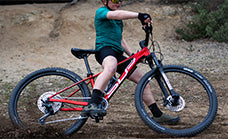







Wheel Fit Explained: Why Mountain Bikes Use Different Wheel Sizes
Why do some mountain bikes roll on 27.5" wheels and others on 29" wheels? Here's how wheel size, frame size, and geometry work together, and how to choose the right setup for your height, trails, and riding style.

Ever noticed that two mountain bikes from the same model range can roll on different-sized wheels? One has 27.5" wheels, the other has 29" wheels, and the spec sheet doesn't say much about why. It isn't random, and it isn't just about making a bike bigger or smaller.
Designers think about rider proportions, frame geometry, handling, the terrain the bike is built for, and the overall design. Matching wheel size and frame proportions to the rider is what we'll call wheel fit. Understanding wheel fit on mountain bikes makes it much easier to compare bikes and buy the right one.
Today's two main mountain bike wheel sizes are:
- 27.5" wheels, usually linked with responsive, nimble handling.
- 29" wheels, usually linked with rolling over obstacles, holding momentum, and staying stable.
Treat these as general tendencies, not guarantees. How a bike actually rides depends on the whole package.
What Is Wheel Fit in Mountain Biking?
Wheel fit means the wheel size suits both the frame it's built into and the rider on it. The wheels interact with almost every other part of the bike's design:
- Rider height and inseam: Your inseam is the length of your inner leg. Together with your height, it decides which frame sizes you can ride comfortably.
- Frame size and geometry: Geometry means the lengths and angles of the frame tubes. These shape your riding position and how the bike handles.
- Reach and standover clearance: Reach is the horizontal distance from the pedals to the handlebar area, so it sets how stretched out you feel. Standover clearance is the gap between you and the top tube when you stand over the bike with your feet flat on the ground.
- Wheelbase and handling: Wheelbase is the distance between the front and rear axles. A longer wheelbase usually feels steadier. A shorter one usually turns more quickly.
- Tire clearance and suspension design: Bigger wheels need more room in the frame and fork, especially when the suspension compresses.
- Riding style and terrain: Twisty singletrack and fast, rocky descents ask for different things from a bike.
A well-designed range keeps these proportions sensible from the smallest frame to the largest. It doesn't just stretch the tubes and leave everything else the same. That's why the wheel size sometimes changes between frame sizes.
A quick note on terminology: 27.5" and 29" are nominal size labels, not exact measurements. The actual outside diameter of the wheel depends on the tire fitted to it, so a large-volume 27.5" tire can come surprisingly close to a skinny 29" setup.
Why Do Mountain Bikes Use Different Wheel Sizes?
1. Rider proportions
Wheel diameter has a big effect on a bike's overall proportions, and you notice it most on small frames. A big wheel takes up space, which makes it harder to give shorter riders a low top tube, enough standover clearance, and a comfortable, upright riding position.
2. Handling and maneuverability
Smaller wheels can make a bike feel more compact and quicker to change direction. Frame design, tire choice, and cockpit setup also shape that feel, so a smaller wheel alone doesn't make a bike agile.
3. Stability and obstacle rollover
Rollover is how easily a wheel gets up and over roots, rocks, and ledges. A larger wheel meets an obstacle at a shallower angle, so in comparable conditions it tends to roll over things more smoothly. That can help you carry momentum and feel more settled on rough ground.
4. Frame and suspension design
Every frame has to fit the wheel, the tire, the suspension travel, the drivetrain, and the rider within a limited amount of space. A larger wheel uses up more of that space. On small full-suspension frames especially, designers have to trade these factors off against each other.
5. Intended riding style
Cross-country, trail, and enduro bikes each balance efficiency, climbing, and descending differently, and that can influence which wheel size a designer picks. Still, wheel diameter alone never decides whether a bike suits a discipline. Geometry, suspension, and build matter just as much.
27.5-Inch vs 29-Inch Wheels: What's the Difference?
| Feature | 27.5" wheels | 29" wheels |
|---|---|---|
| General handling feel | Often responsive and maneuverable | Often stable and momentum-oriented |
| Obstacle rollover | Smaller effective wheel radius | Larger effective wheel radius |
| Tight, technical trails | Can feel easier to maneuver in some setups | Can take more effort to change direction in some setups |
| Momentum | May lose momentum sooner in some conditions | Often holds momentum well |
| Weight | Can be lighter, depending on the build | Can be heavier, depending on the build |
| Frame design | Can suit compact frame proportions | Can suit larger frame proportions |
| Best choice | Depends on rider, bike design, and terrain | Depends on rider, bike design, and terrain |
This table shows general tendencies. Real-world results depend on tire width and pressure, rim and tire construction, frame geometry, suspension, your riding technique, and trail conditions. Neither size is better across the board.
Why Do Some Mountain Bikes Use 27.5-Inch Wheels on Smaller Frames?
Some designers put 27.5" wheels on their smaller frame sizes because it can help:
- Keep the frame proportions balanced.
- Provide enough standover clearance.
- Keep the handling responsive.
- Allow suitable reach and stack for shorter riders. Stack is the height of the front end.
- Avoid compromises such as a high front end or limited tire clearance that can come from squeezing big wheels into a compact frame.
That said, being shorter doesn't mean you automatically need 27.5" wheels. Plenty of well-designed 29" bikes come in small sizes that fit shorter riders well. The geometry chart will tell you.
Why Do Larger Mountain Bike Frames Often Use 29-Inch Wheels?
On bigger frames, 29" wheels are a natural fit. They match the overall size of the bike to a taller rider, add rollover on uneven terrain, help with momentum and stability, and support a balanced riding position.
Designers don't all make the same choices, though. Some ranges use 29" wheels on most or all frame sizes. Others mix wheel sizes across the range or by model. There's no industry-wide rule linking Small, Medium, Large, or XL frames to a particular wheel size, so always check the spec of the exact bike and size you're looking at.
What Is a Mixed-Wheel or Mullet Mountain Bike?
A mullet (or mixed-wheel) bike runs a 29" wheel up front and a 27.5" wheel in the back. "Business up front, party in the back." The idea is that:
- The bigger front wheel helps roll over obstacles.
- The smaller rear wheel gives more clearance behind you on steep terrain and allows a more compact rear end.
- Together they can balance rollover with maneuverability, depending on the bike's geometry.
Mullet setups are a design choice for particular riders and trails. They're not automatically better than matching wheel sizes front and rear.
How to Choose the Right Mountain Bike Wheel Size
When you're comparing bikes, work through these steps:
- Measure your height and inseam.
- Check the manufacturer's recommended frame size for your measurements.
- Compare reach, standover clearance, and riding position on the geometry chart.
- Think about your trails. Are they tight and twisty, or open and rough?
- Decide which feel you prefer: compact and lively, or the rollover and momentum that bigger wheels offer.
- Look at the whole bike, including tires, suspension, and geometry, not just the wheel size.
Quick decision guide
- If you love tight, technical, flickable trails, a 27.5" bike or a mullet setup is worth a look.
- If you ride lots of rough, rooty, or long rolling trails, consider a 29" bike.
- If you're between sizes or unsure, choose the frame that fits you best and let the wheel size follow from that.
A comfortable fit and a careful look at the geometry chart will help you more than wheel diameter alone.
Frequently Asked Questions
Why do mountain bikes have different wheel sizes?
Different wheel sizes help designers balance fit, handling, and terrain performance. Wheel size affects frame proportions, standover clearance, rollover, and suspension packaging, so the right choice depends on the rider and the intended use.
Are 27.5-inch wheels better for shorter riders?
Not necessarily. 27.5" wheels can make it easier to build a well-proportioned small frame, but many 29" bikes also fit shorter riders well. Check the geometry and the available frame sizes.
Are 29-inch wheels better for taller riders?
Often, but not always. 29" wheels tend to match the proportions of larger frames, but taller riders can still enjoy 27.5" bikes. Fit and riding preference matter most.
What is the difference between 27.5-inch and 29-inch mountain bike wheels?
29" wheels are larger in diameter. They generally roll over obstacles more easily and hold momentum well, while 27.5" wheels generally feel more nimble. Actual results depend on the tires, geometry, and suspension.
Are 29-inch wheels better for riding over rocks and roots?
Generally, yes, in comparable conditions. A larger wheel meets obstacles at a shallower angle, which tends to improve rollover. Tire pressure, suspension, and technique also play a big part.
Can a shorter rider comfortably ride a 29-inch mountain bike?
Yes, if the frame is designed for it. Look for a small frame size with enough standover clearance and a reach that suits you.
What is a mullet mountain bike?
A mullet bike uses a 29" front wheel and a 27.5" rear wheel. The aim is to combine front-end rollover with a more compact, maneuverable rear end.
Should I choose a mountain bike based on wheel size or frame size?
Start with frame size. A bike that fits you properly will ride better than one chosen for its wheel size alone. Once you know your size, compare wheel options within it.
Find the Right Mountain Bike at BikesOnline
Now that you know how wheel fit works, compare a few bikes side by side. Head to the Mountain Bikes section of the BikesOnline US store, where you can browse hardtail and dual-suspension options. Each bike lists its wheel size and geometry so you can match it to your height and your trails. Find your fit, get it delivered to your door, and ride more for less.